If you've been circling Norwood as a place to buy a triple-decker, underwrite a small apartment deal, or just watch what your existing property might be worth next to a rezoned parcel, you've probably run into the number: 2,045. That's the unit capacity Norwood was required to zone for under the state's MBTA Communities law, and it shows up in nearly every conversation about the town's future. It is also, on its own, close to useless for making a decision. The number that matters if you're actually underwriting something in Norwood this year is one. That's how many projects have broken ground under the new zoning since it passed.
Understanding why those two numbers coexist, and what separates the site that worked from the roughly 1,300 apartments sitting untouched inside the same rezoned areas, tells you more about where money can actually move in this market than the headline ever will.
Where 2,045 comes from
The MBTA Communities law, passed in 2021, requires the 177 cities and towns served by the MBTA to zone at least one district where multifamily housing is allowed as of right, meaning no special permit, no discretionary board vote, just a building permit. For a commuter rail town like Norwood, the law sets the bar at a minimum gross density of 15 units per acre across at least 50 acres, all within a half mile of a station. Run that math on Norwood's three commuter rail stops, Norwood Central, Norwood Depot, and Windsor Gardens, and the town lands on a required capacity of 2,045 units, a figure the town's own planning department has published directly.
That number describes a ceiling, not a plan. It assumes every parcel in the district gets bought, demolished, and rebuilt at maximum height and density. Norwood's own Community Development Department has been more direct about what it actually expects: something closer to 300 new units over time, not 2,045.
Why the ceiling and the floor are so far apart
The gap isn't a compliance shortcut or a political dodge. It's arithmetic. Reporting on the law's rollout found that roughly 1,300 apartments already exist inside the half-mile zones Norwood rezoned, including established communities like Windsor Gardens, Avalon, The Crossings, Lenox Station, and Print Lofts. None of those buildings are going anywhere, because there's no financial case for tearing down an occupied, rent-paying property to build a marginally bigger one in the same footprint. The zoning permits that outcome. It doesn't make it profitable.
That leaves a narrow category of parcels where redevelopment actually pencils out: vacant or underused land, often former industrial or commercial sites, where there's no existing income stream to replace and often environmental remediation that makes public reinvestment or subsidy more attractive to the town anyway.
Here's how the three MCMOD subdistricts differ on paper, which matters more than the total unit count once you're looking at a specific parcel:
| Subdistrict | Front setback | Built context |
|---|---|---|
| Norwood Depot | 5 feet | Matches the Central Business District storefront pattern, built to support mixed-use retail |
| Norwood Central | 20 feet, with upper stories stepped back | Sits across Lenox Street from mostly single-family and two-family homes, buffered intentionally |
| Windsor Gardens | Tied to existing multifamily context | Anchored around an already-built apartment complex |
The Norwood Central setback rule is worth sitting with if you already live on a residential street near that district. The town wrote the 20-foot setback and the step-back requirement specifically because the subdistrict borders existing single-family and two-family blocks, and the goal was preserving that residential feel next to whatever gets built. The zoning was drawn to concentrate change on a small number of parcels, not to reshape the streets around them.
The one site that worked, and why
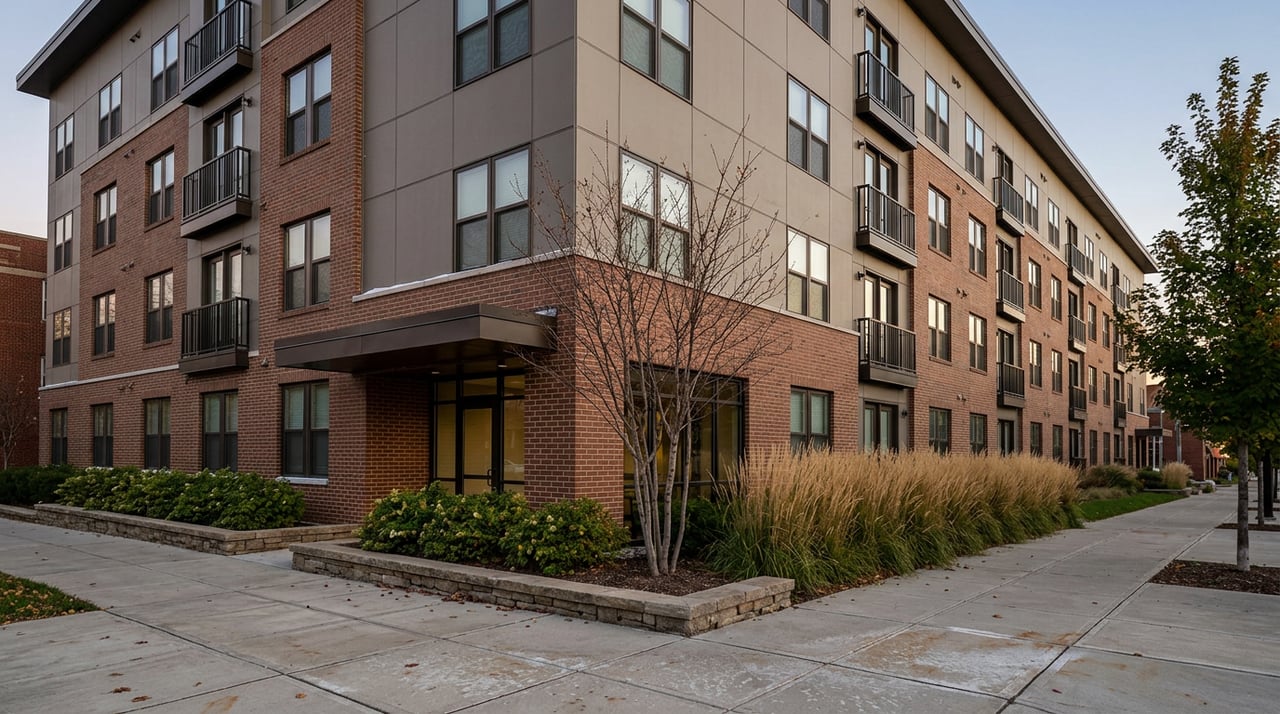
The project that actually broke ground is 259 Lenox St., a 145-unit, five-story building going up on a former industrial site adjacent to the Norwood Central commuter rail platform, within walking distance of Norwood Town Square and Norwood Plaza. Beacon Bank closed a $44.5 million construction loan for the project in June 2026, arranged by Colliers on behalf of developer Tremont Asset Management, working alongside SV+Partners, architect EMBARC, and contractor Callahan Construction Managers. Twenty percent of the units are designated affordable, consistent with Norwood's inclusionary zoning rule that projects of 16 units or more owe a 20 percent affordable set-aside, double the 10 percent required for smaller 8 to 15 unit developments.
The site itself tells you what made this deal different from the roughly 1,300 apartments sitting untouched nearby. Tremont and SV+Partners acquired the industrial parcel for $2.3 million in February 2021. Norwood's Town Meeting actually rejected an earlier rezoning proposal tied to the project in 2022, before it cleared later as part of the town's broader MBTA Communities compliance package. Even the exception wasn't a straight line. It took years of site control, a failed first attempt, and a state mandate that eventually swept the parcel into a compliant district before financing closed.
"We identified this site for its exceptional transit connectivity and spent several years planning a project that will elevate the multifamily housing offering in Norwood," said Sam Slater, managing partner at Tremont Asset Management, when the groundbreaking was announced.
Construction started in late June 2026 and is expected to wrap in late 2027, which puts the project only a few months into an 18-month build as of this fall. It will be Norwood's first large-scale multifamily delivery since Avalon Norwood added close to 200 units back in 2020.
What the rental math says about why this pencils
The 259 Lenox St. deal isn't happening in isolation from the rest of the rental market. The broader Route 1 South submarket, which includes Norwood alongside Dedham, Westwood, Canton, Walpole, Sharon, Stoughton, and Foxborough, has posted average annual rent growth of 4.8 percent over the past five years, with occupancy holding above 95 percent, according to Colliers. Within a one-mile radius of the Lenox Street site specifically, close to 1,000 apartment units have been absorbed over that same five-year window, and 46.1 percent of households in that radius are renters.
That's a landlord's market with or without a single new building. It's also part of why a five-story, 145-unit project with a pool, fitness center, and co-working space can justify its construction costs in Norwood even while most of the newly rezoned land sits untouched. The fundamentals support new supply. The economics just don't support tearing down what's already there to get it.
What this means if you're underwriting a deal here
If you're looking at Norwood as an investor, the mistake is treating the whole MCMOD overlay as one opportunity set. The parcels worth evaluating share a specific profile: underused or vacant land rather than an occupied building, inside the half-mile radius of one of the three rail stops, and ideally in a subdistrict like Norwood Depot or Norwood Central where the setback rules were written to support new construction rather than just tolerate it in theory.
If you already own a home on an existing residential street near one of these districts, the practical answer is more reassuring. The subdistricts were deliberately buffered away from occupied single-family and two-family blocks, and the parcels where redevelopment actually makes financial sense are a small, identifiable subset, not a blanket rule for every lot within a half mile of the train.
Meanwhile, the resale market keeps moving on its own separate timeline. Norwood's median sale price sat at $780,000 over the three months ending in May 2026, up 3.9 percent from the same period a year earlier, with homes going under agreement in roughly 19 to 20 days. That pace has nothing to do with whether 259 Lenox St. delivers on schedule. It's a reminder that the zoning story and the resale story are two different markets running in parallel, and conflating them is the easiest way to misjudge either one.
A few questions this raises
Will Norwood actually reach 2,045 new units? Nothing in the current pipeline points that direction. The town's own planning estimate lands closer to 300 units over time, and as of this fall only one project has broken ground.
Does this zoning force me to sell or redevelop if I already own property in the district? No. The law requires the town to permit multifamily housing by right within the mapped subdistricts. It doesn't require any owner to build it, and it doesn't touch property outside those specific zones.
What happens once 259 Lenox St. delivers in late 2027? It becomes the first real data point for how a project like this performs in Norwood's rental market, and likely the benchmark other underused parcels in Norwood Central and Norwood Depot get measured against before anyone else attempts something similar.
If you're weighing a Norwood parcel against this backdrop, or trying to figure out what your existing property is worth with this zoning change now in the picture, Charles Haritos can walk through the specific subdistrict rules and comparable rental data with you before you commit to anything. Get your instant home valuation and start with a clear picture of where you actually stand.